Founder, Designer, Developer
Heavy Equipment AI
Launched September 2026
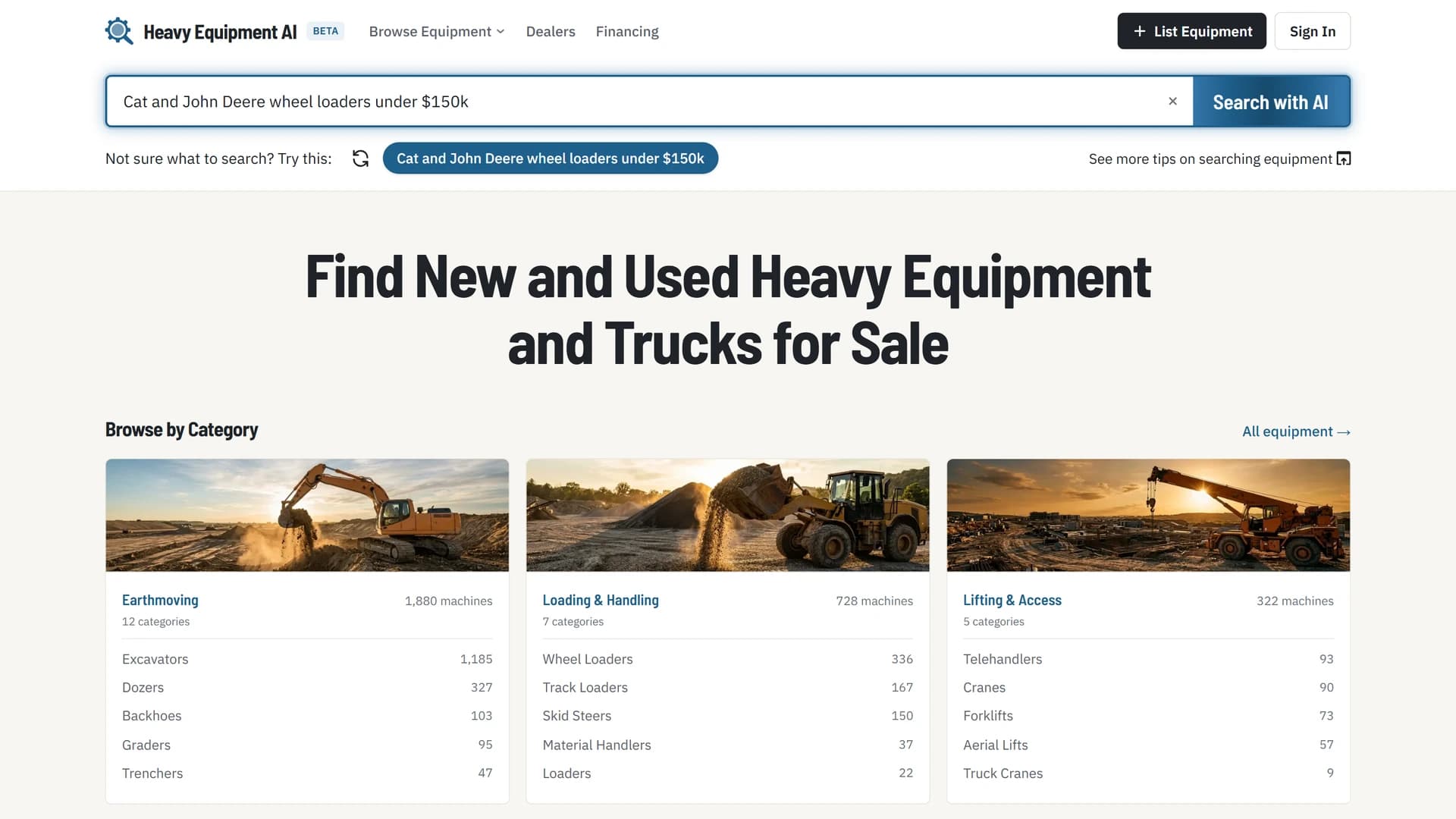
Visit live site →A searchable heavy equipment directory I built solo. It brings listings from dozens of dealer websites into one place, and buyers search it by describing the machine they want.
Context
Heavy Equipment AI is a searchable directory that brings listings from dozens of dealer websites into one place. Buyers browse machines across construction, trucking, agriculture, forestry, and more, then click through to the seller. Revenue comes from financing referrals to a heavy equipment broker, and dealers can manage their listings in their own portal or choose to have us index their existing websites.
Challenge
Heavy equipment is a huge, fragmented market. Inventory is spread across hundreds of small dealer sites, each built differently, and the big marketplaces are paywalled or blocked. A buyer who wants a used excavator in Ohio under $60k has to visit dozens of sites and click through the filters on each one.
A directory is only worth using if it’s broad, accurate, and fast to search. Those three requirements shaped everything I built.
Approach
Natural-language search
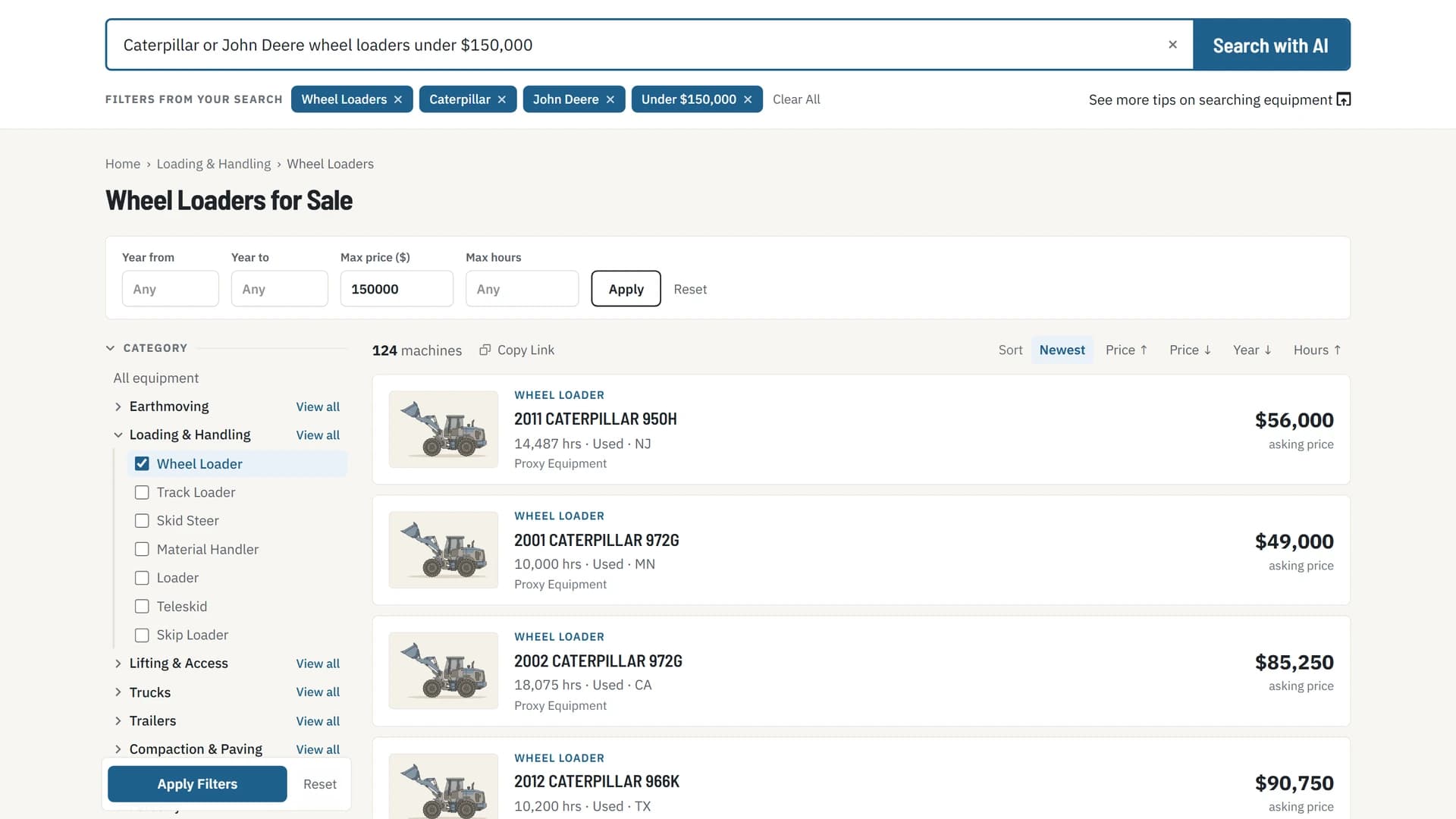
Search is the headline feature. A buyer describes what they want in a single sentence, like “john deere excavators and dozers in new york or new jersey under $50k.” One call to Google’s Gemini turns it into structured filters (category, make, state, price, year, and hours) and lands the buyer on the normal results page. Each filter appears as a removable chip, so the buyer sees exactly how their sentence was understood.
The AI only ever outputs a query. It never makes claims about a machine, so it can’t invent a spec or a price. If Gemini is slow or down, a rules-based parser I wrote takes over, so search never breaks.
Dealer data pipeline
I vetted every dealer source by hand, then built the system that reads their sites. It runs on a few reusable adapters, one per website platform rather than one per dealer. It respects robots.txt, identifies itself honestly, and never spoofs a browser. Sold machines are detected and kept off the browse pages.
Category illustrations
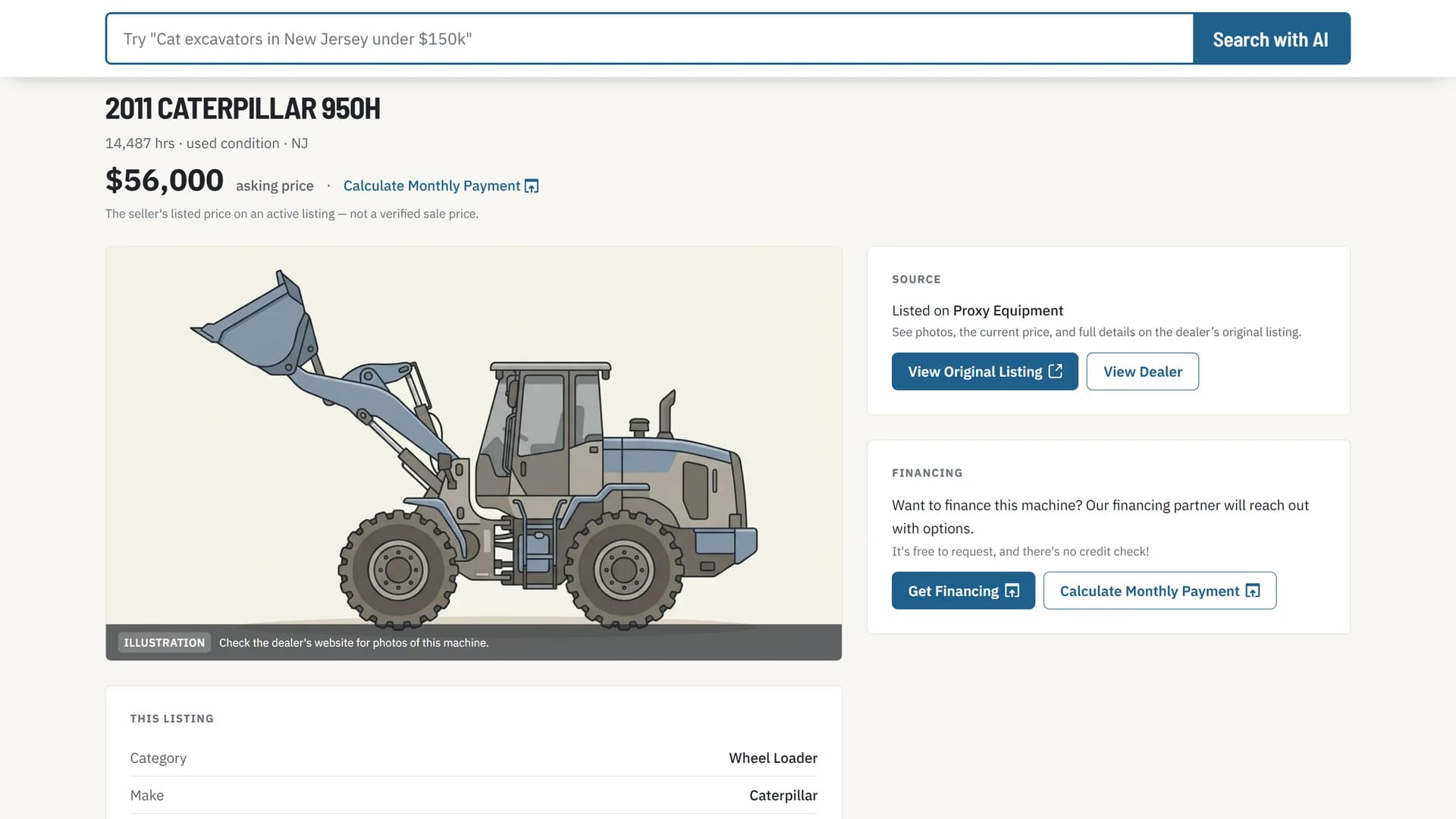
Listings without photo permission show a custom illustration of the machine’s category: excavator, dozer, skid steer, and so on. I generated the set with Nano Banana in one consistent, unbranded flat-vector style. They’re deliberately stylized and never photoreal, so no one mistakes an illustration for the actual machine for sale.
Financing referrals
Every active listing has a “Get Financing” button and a monthly-payment calculator. Buyers submit a request with clear disclosure and recorded consent, and the lead goes to the heavy equipment broker I partnered with. The site is the lead source; the broker earns the loan. Buyers can opt out at any time, and the system can’t deliver a lead without a consent record.
Dealer portal
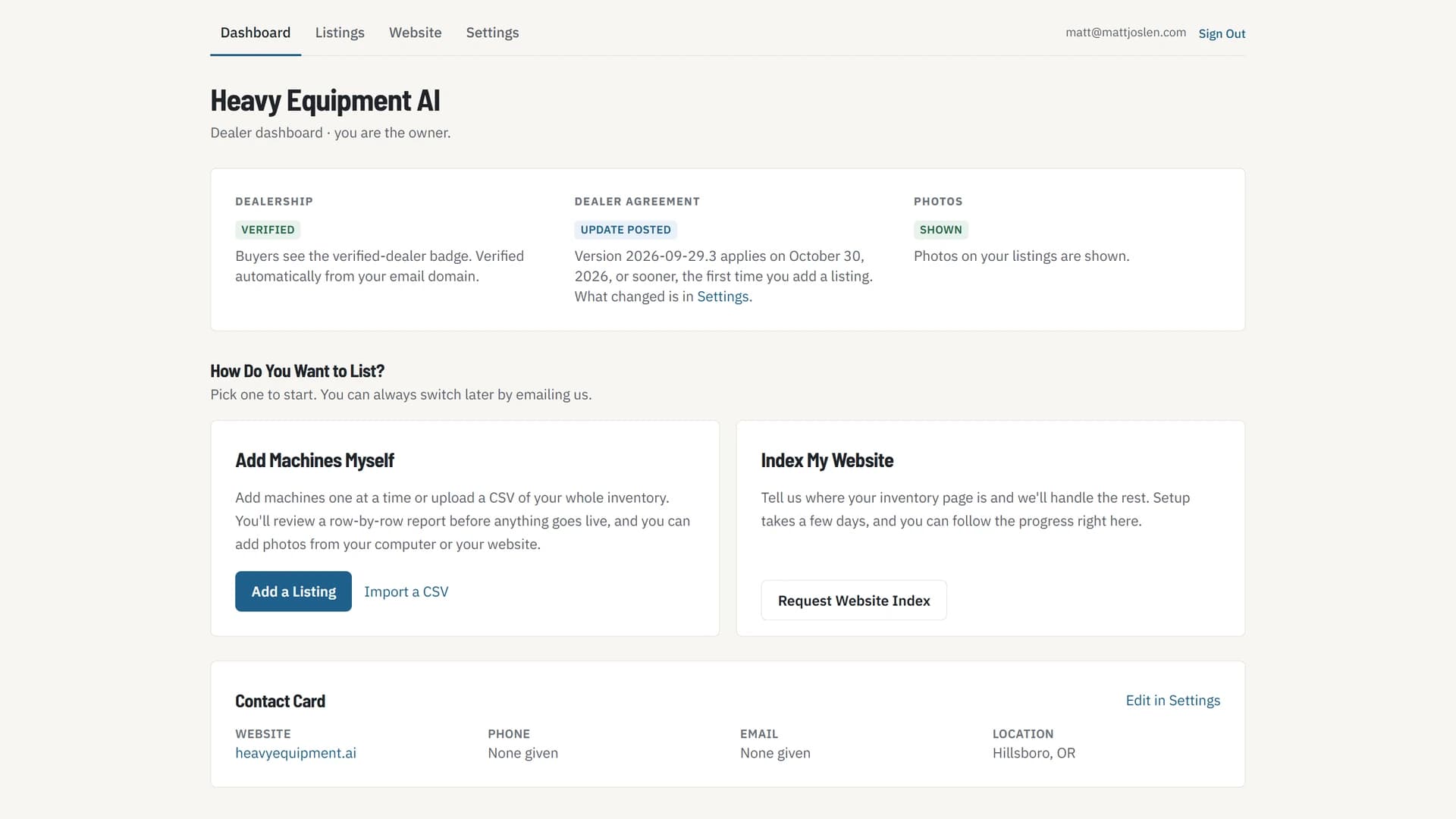
Dealers can create an account, verify their dealership, accept the dealer agreement, and upload listings with photos one at a time or by CSV, or ask to have their existing website indexed instead. Dealers also get public pages with contact info and inventory filters.
Internal CRM and admin tools
Behind the site is a lightweight CRM for dealer outreach: lead status, tasks, a call and email timeline, do-not-contact flags, and a pipeline from first contact to written approval. It’s tied to live site data, so I can see which dealers are already on the site and which aren’t. An admin area handles dealer onboarding, listing approvals, removal requests, and upload review.
Stack
Next.js and TypeScript on Vercel, Postgres on Supabase, Gemini for search, Nano Banana for the illustrations, and Resend for email. I built it end to end, with Claude Code as my AI pair-programmer.
Key Decisions
Directory first
I originally planned an AI chatbot and price-estimation product. I pivoted because a directory with broad coverage was the more useful, shippable product, and financing referrals gave it a revenue path. I’ve deferred the deeper AI features.
Photos are earned, not scraped
Copying dealer photos creates real copyright exposure, so listings launch without them. Illustrations fill the gap, and real photos earn their way onto the site when a dealer opts in through the portal and grants a photo license.
Accuracy over volume
A wrong hour meter or price on a six-figure machine destroys trust. Before any source is written to the index, automated checks compare what the pipeline pulled against listings I verified by hand. If the sample listings don’t match, the pipeline refuses to write that source, so a bad scrape gets caught instead of published.
Security and privacy from day one
Database-level access rules protect personal data. Staff accounts are separate from dealer accounts and require two-factor authentication, and the CRM data is private by design. There are no third-party trackers on the site, and sensitive links are kept out of analytics.
Outcome
~8,000
Listings indexed
~5,800
Currently for sale
26
Vetted dealer sources
100+
Equipment categories
Heavy Equipment AI is live, with everything described above in production: natural-language search and its fallback parser, the validated dealer pipeline, category illustrations, financing referrals, the dealer portal, and the internal CRM. Indexed listings that aren’t for sale have sold or been removed.
Selected Visuals
Reflection
The most useful AI in this product is also the most constrained. It never says anything about a machine; it only turns a sentence into filters the buyer can see and undo. The same instinct shaped the rest of the build: a broad, accurate directory instead of the chatbot I first planned, and honest illustrations instead of scraped photos. When someone is shopping for a six-figure machine, the product has to be right before it can be clever.