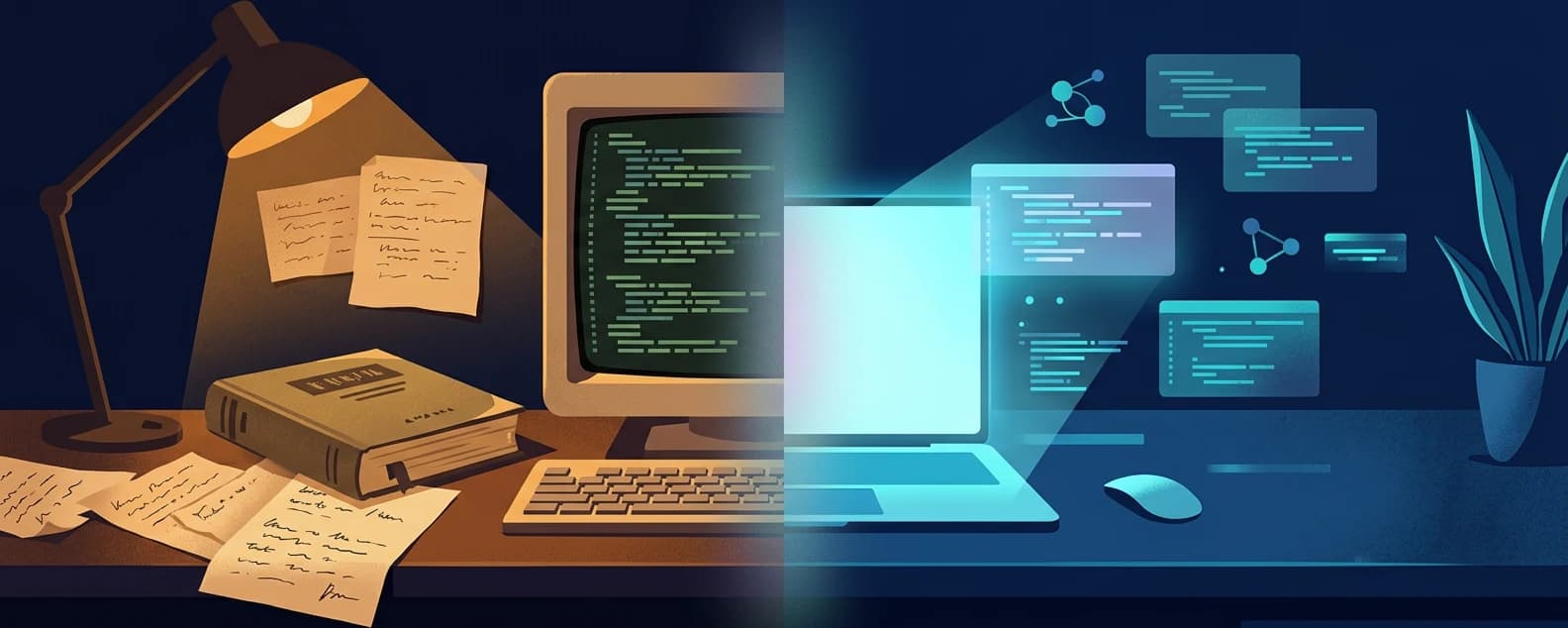
The rise of complex coding LLMs, particularly since mid-2025, birthed the biggest divide in software development practices since Richard from Silicon Valley broke up with his girlfriend for using spaces instead of tabs. Except, this time, there is actual weight to the debate.
Pre-AI
Before agentic coding really existed, developers were generally broken up into three main camps:
-
The truists. Developers who hand-coded everything, arguing that you're not a true developer unless you are deep into the codebase.
-
The hobbyists. Developers who used low-code/no-code platforms, such as WYSIWYG (meaning "What You See Is What You Get"; pronounced like "Wizzy-Wig") builders on CMS platforms like WordPress.
-
The in-betweeners. Developers who knew how to code but were also lazy and preferred to automate and streamline as much as possible, only digging into the code when absolutely necessary. Embracers of the true spirit of engineering, I'd argue.
Admittedly, I started in the first camp after I graduated with my degree in software engineering because I wanted to prove that I was a "real" developer (I was in for a rude awakening). Soon enough, I tossed aside that mindset and transitioned into the third camp after realizing that the final product is all that matters, not how I got there. You might see where I'm going with this.
2022-23 AI
I was one of the original users of ChatGPT when it first released to the public toward the end of 2022. Despite its clear faults (and its inability to access the internet) my mind was truly blown by how it could not only spit out information at the speed of sound, but also generate curated answers to specific problems.
At the time, I had just started working with a client to redesign his Shopify website, which also had a major SEO problem. He and his non-technical/non-marketing team had written the copy for all of their product pages. Not only was the copy substantially lacking, but the pages' HTML and meta tags were even worse. As a web professional, the latter was easy enough to fix, but rewriting product descriptions for dozens and dozens of page listings proved to be more tedious. I'm not opposed to writing on what I'm passionate about, but unfortunately, commercial gym equipment doesn't fall on that list.
"Have you checked out ChatGPT?" he asked me.
"I'm glad you said that," I responded. "I want to use it to rewrite your product descriptions, and then I'll pop them into their pages while I simultaneously fix the HTML and other SEO problems."
He agreed.
Within a matter of months, the website's organic traffic (Google search, etc.) surged by 236%.
I was officially hooked on the premise of LLMs when it came to researching subjects, helping me brainstorm ideas, and writing (good enough) copy.
2024 AI
Sometime in 2024, I was aware that AI had advanced to some degree and now had access to the internet. I was still using ChatGPT as a search engine and the occasional copywriting, but it really wasn't a big part of my workflow. I must have picked up the idea that ChatGPT could also spit out a bit of code, so I decided to ask it to build me a mobile-friendly navigation bar. After a few grueling hours attemping to guide the bot like I was a senior dev stuck with the intern for the day, I finally... gave up. It simply couldn't do it, and I decided I was done trying that ever again.
Early 2025 AI
By early 2025, AI was starting to pop up everywhere, both in consumer-facing software as well as brand new AI-specific tools. Between Google asking me if I need help writing my emails (yes I do, thanks), Midjourney generating phenomenal, realistic images, and the vast majority of marketing copy so clearly AI-written, it was truly everywhere and not going anywhere.
In March of 2025, I began developing a marketing site for a new business I was starting called Accessibility Roasts, which was essentially a productized accessibility audit service for web pages. Claude had been gaining popularity for its advanced ability to code, so I decided to try it out.
"How can I make a CSS border have a linear gradient?" I asked it skeptically, ommitting additional context as if I was grading its answer for an exam. (It was for a button; I suppose I could have at least told it that.)
I was shocked by its response. Not only did it generate a functional CSS class with placeholder variables, but it then provided a second, more complex approach in case I wanted to use it as a pseudo-element.
It was the first time I realized that not only can AI save me time researching topics, but it can now save me time researching how to code certain things.
Mid-2025 AI: Vibe Coding
Despite my success generating a cool button with Claude, I still didn't adopt it into my workflow, yet.
Then vibe coding entered the scene, and, like many... I kind of hated it at the time. Suddenly, people who had never written a single line of code in their lives were generating full-stack applications and shipping them with zero user testing and zero QA (quality assurance) reviews. My instinct about that was right as many of these new vibe coded SaaS products on the market were horribly unstable and unsecure with multiple instances of customers' PII (Personally Identifiable Information) leaking to the public. However, just like my earlier attitude toward WYSIWYG tools, my mindset about optimal AI-assisted development was wrong.
The industry has shifted into three new, although familiar camps:
-
The truists. Developers who hand-code everything and refuse to adopt AI into their development workflow.
-
Vibe coders. The people developing with AI exclusively, and are willing to ship out a program without a shred of understanding about what's going on under the hood.
-
The in-betweeners. Developers who utilize AI to help speed up the coding process while still having a full understanding about how it all works.
2026 AI
Throughout 2025, I once again began transitioning from the first camp to the third camp. Devs that I respected began adopting AI into their workflows, and industry personalities on YouTube and X (formerly known as Twitter) that I followed began raving about AI.
Then, on February 10, Matt Schumer published a long-form article on X titled Something Big is Happening, which has garnered an impressive 87 million views by the time of this writing. Inside, Matt outlines the incredible breakthroughs that both OpenAI's and Anthropic's newest models had achieved in software development. Only five days earlier, in the documentation for their newest model, OpenAI attributed GPT-5.3 Codex to being "instrumental in creating itself."
Matt goes on to explain that everyday life for the average person is destined to soon change drastically, for better or for worse, and he certainly makes some compelling points. Regardless of the future of mankind, this article was a real turning point for me in my career. I knew it was time to adapt or get left behind. At the risk of sounding dreadfully unoriginal, it truly felt like I had taken the red pill from Morpheus's hand in The Matrix.
Within these last several months, Claude has become an instrumental part of my everyday workflow: from conducting deep research into industry trends and competitive landscapes, to quick design prototyping, to full-scale development. Nothing I couldn't do on my own before! The difference is that now I can do them as if there are 10 of me under my orchestration. AI has effectively pried open the bottlenecks and filled in the gaps.
Final Thoughts: 2026 and Beyond
The trick to vibe coding (and what categorizes this as "AI-assisted development" rather than true vibe coding) is having the knowledge and ability to keep the AI accountable for what it creates. My development background gives me an edge because I can guarantee that whatever I build with AI, I could still build on my own (albeit slower) if it were to disappear tomorrow — no doubt, a possibility given both the massive subsidization of consumer LLMs as well as the high likelihood of government overreach, but I suppose that's a topic for another post.
AI is just a tool. A very powerful tool that is currently flipping society upside-down, but a tool nonetheless. Proven by the previous Industrial Revolutions, I believe in the concept of abundance through technological breakthroughs. AI is changing the game rapidly, and there is plenty of reason to believe it will be for the better. Jobs will be lost; jobs will be created; the Earth will keep spinning until it no longer does.
AI was not used in the writing of this article